
Few places on Earth spark curiosity like the Nazca Lines vast ancient designs etched into Peru’s desert floor that can only be fully appreciated from above. Travelers who visit these legendary geoglyphs often ask the same question: how were they actually made without modern technology?
At Andean Travel Experience, we believe journeys should go beyond sightseeing they should reveal stories, ingenuity, and cultural brilliance. Understanding how the Nazca Lines were created transforms your visit from a scenic flight into a profound encounter with ancient innovation, precision engineering, and spiritual symbolism.
This guide explores the methods, tools, theories, and discoveries behind their construction combining verified research with expert travel insight so you can experience one of Peru’s greatest wonders with deeper meaning.
What Are the Nazca Lines?
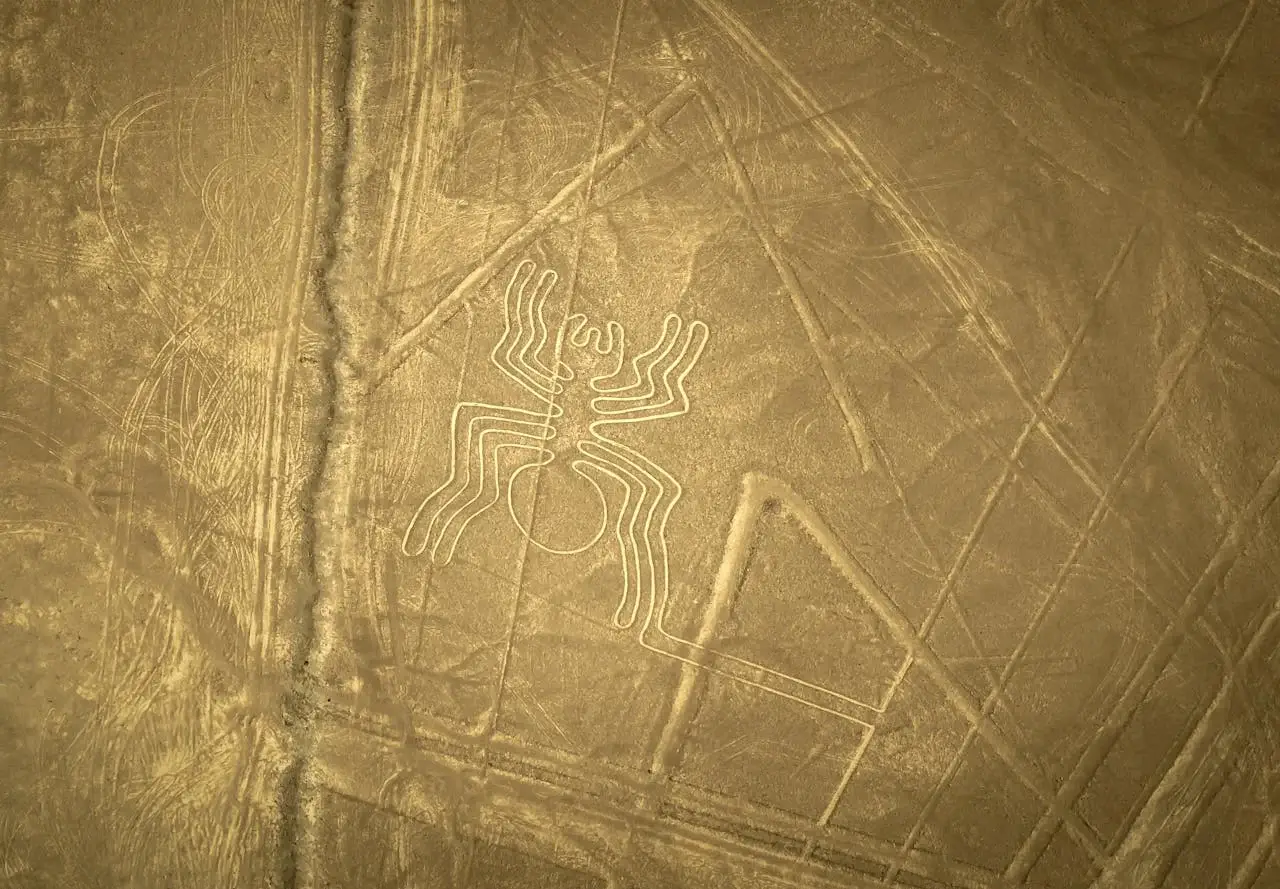
The Nazca Lines are massive geoglyphs carved into Peru’s southern desert by the Nazca culture between roughly 200 BCE and 600 CE. More than 800 straight lines, 300 geometric figures, and dozens of animals and plants form one of the world’s largest archaeological artworks.
They are recognized globally for their scale, mystery, and precision.
Where Are the Nazca Lines Located?
The lines stretch across Peru’s coastal desert plains, an environment uniquely suited for preservation due to:
Extremely dry climate
Minimal wind erosion
Flat terrain
Lack of vegetation
These natural conditions are a major reason the geoglyphs remain visible after two millennia.
Who Created the Nazca Lines?
Archaeological evidence shows they were created by the Nazca civilization, descendants of earlier regional cultures. Researchers agree they possessed advanced knowledge of:
Geometry
Land surveying
Symbolic design
Cooperative labor systems
Scholars emphasize that construction likely occurred across generations rather than during a single period.
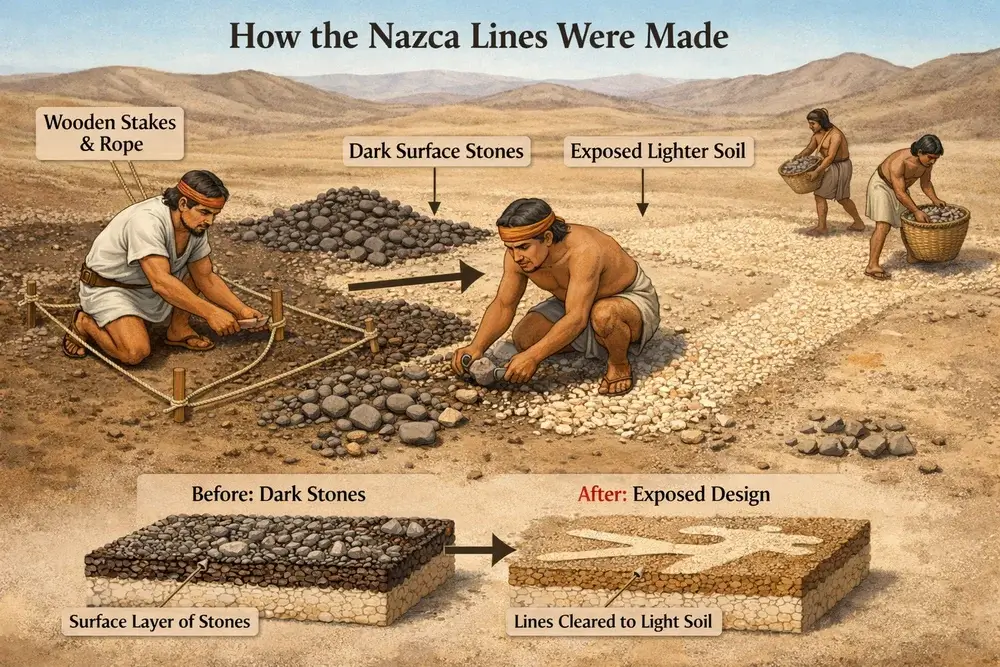
How the Nazca Lines Were Made — Step by Step
Archaeologists generally agree on the basic method used to create the lines:
Step 1: Planning the Design
Designs were first mapped on a small scale, possibly using grids or proportional measurements.
Step 2: Marking the Ground
Wooden stakes and ropes helped outline shapes and maintain symmetry. Some stake holes have been discovered and dated.
Step 3: Removing Surface Stones
Workers removed the top layer of dark, iron-oxide-coated pebbles.
Step 4: Revealing the Contrast
Underneath lies pale sand and clay. The color contrast created visible lines without carving deep trenches.
Step 5: Maintenance
Some lines appear to have been refreshed over time, suggesting ongoing cultural significance.
Key Insight: The Nazca Lines were not built by digging deep trenches but by subtracting surface material.
Tools and Engineering Techniques
Despite lacking metal tools or machinery, the Nazca people achieved remarkable precision using simple technology:
Wooden stakes for alignment
Ropes for straight lines
Stone tools for clearing rocks
Human teamwork for scale
Archaeologists consider the project evidence of organized labor and sophisticated planning.
→ The Mystery of the Nazca Lines
Why the Nazca Lines Have Survived for 2,000 Years
Their longevity is not accidental it’s environmental science:
- Rainfall is extremely rare
- Winds are gentle and stable
- The soil forms a natural crust protecting the designs
Without these conditions, the geoglyphs would have disappeared centuries ago.
Scientific Discoveries About Construction
Recent field studies using drones and aerial imaging including surveys conducted by researchers from Yamagata University have identified hundreds of additional geoglyphs.
These discoveries confirm:
- Multiple construction phases
- Different artistic styles
- Variation in scale and technique
Researchers suggest there may still be undiscovered figures hidden beneath desert sediment.
Theories About Why They Were Made
(Scholarly debate continues no single theory is universally accepted.)
Leading academic hypotheses propose they may have functioned as:
- Ritual pathways
- Ceremonial landscapes
- Astronomical markers
- Communication routes between settlements
Experts caution that while evidence supports aspects of each theory, none fully explains all designs.
Best Ways to See the Nazca Lines Today
Luxury travelers seeking a deeper experience can choose from:
- Private Scenic Flights best perspective and photography
- Expert-Led Archaeological Tours cultural interpretation
- Observation Towers ground-level viewing option
- Tailor-Made Experiences curated itineraries combining Nazca, Paracas, and Ica
Expert Travel Tips
For the best experience:
- Visit May–October for clear skies
- Book flights early during peak season
- Sit on the right side of aircraft for optimal views (pilot dependent)
Avoid heavy meals before flights due to turbulence
FAQs
Were the Nazca Lines made all at once?
No confirmed evidence suggests they were. Many researchers believe they were created over generations.
Did aliens make the Nazca Lines?
There is no scientific evidence supporting this idea. Archaeological research attributes them to the Nazca civilization.
How long did it take to create one geoglyph?
Exact timelines are unknown. Estimates vary depending on size, complexity, and workforce.
Why can they only be seen from above?
Some smaller figures are visible from nearby hills, but their full shapes are best appreciated from the air due to scale.
The Nazca Lines are more than archaeological drawings they are a testament to human imagination, collaboration, and ingenuity. Understanding how they were made transforms a visit into a meaningful journey through time.
“The Nazca Lines remind us that ancient civilizations didn’t lack technology they mastered the tools they had.”
The Nazca Lines stand as one of humanity’s most extraordinary achievements vast desert artworks created with precision, vision, and purpose long before modern technology existed. While scholars continue to study their meaning, what is certain is the remarkable ingenuity of the ancient Nazca people, who transformed a barren landscape into a lasting cultural legacy visible from the sky.
At Andean Travel Experience, we believe journeys should reveal stories hidden beneath the surface. And few places reveal them as powerfully as the Nazca Desert. Plan your Peru Trip Now.