
Hidden among the green mountains of Pasco's Selva Central, Pozuzo is one of Peru's most distinctive destinations.
Here, wooden houses with European influences stand among tropical vegetation, rivers and mountain landscapes. German and Austrian traditions coexist with Peruvian and Amazonian culture, while local cuisine brings together European recipes and ingredients from the surrounding valleys.
But Pozuzo is much more than an unusual architectural destination.
Its story began in the 19th century, when Austro-German settlers undertook an extraordinary journey from Europe to the Peruvian Amazon. Today, that history remains visible in its churches, houses, bridges, museums, food, festivals and family traditions.
In 2023, Pozuzo was recognized by UN Tourism as one of the Best Tourism Villages, and in December 2025 Peru's Ministry of Foreign Trade and Tourism designated it a Pueblo con Encanto del Perú.
For travelers looking beyond the classic Peru itinerary, Pozuzo offers something parti
Where Is Pozuzo?
Pozuzo is a district in the province of Oxapampa, department of Pasco, in central Peru.
It lies in the transition between the Andes and the Amazonian foothills, within the broader Selva Central region.
The town and surrounding area sit at elevations ranging approximately from 600 to 1,850 meters above sea level, creating a warm, humid environment very different from the high-altitude landscapes of Cusco or the dry coast of Lima.
Pozuzo is also connected to one of Peru's important conservation landscapes: the Yanachaga-Chemillén National Parkand the Oxapampa-Asháninka-Yánesha Biosphere Reserve.
This combination makes the destination especially interesting for travelers who want to combine cultural discovery with nature and biodiversity.
The Story of Pozuzo: A Journey Across Continents
To understand Pozuzo, it is essential to understand its history.
During the 19th century, the Peruvian government promoted European immigration and colonization projects in parts of the country's eastern territories.
An agreement was signed in 1855 between the Peruvian government and the German baron Cosme Damián Freiherr Schütz von Holzhausen to establish a European settlement in the Pozuzo region.
In 1857, a group of Austrian and German emigrants began their journey from Europe.
According to the historical records compiled by Peru's National Library and MINCETUR, the expedition included people from Tyrol and German-speaking regions. They traveled from Antwerp, Belgium, across the Atlantic and eventually reached Peru before beginning the difficult overland journey toward the eastern Andes.
Their journey was far from easy.
The route toward Pozuzo crossed difficult terrain, and the settlers had to establish a community in an environment very different from Europe.
In July 1859, the first settlers established the colony of Pozuzo.
A second group of Austro-German settlers arrived in 1868, further strengthening the community.
Over generations, the original European traditions evolved alongside Peruvian cultures and the realities of life in the Selva Central.
That cultural fusion is what makes Pozuzo particularly fascinating today.
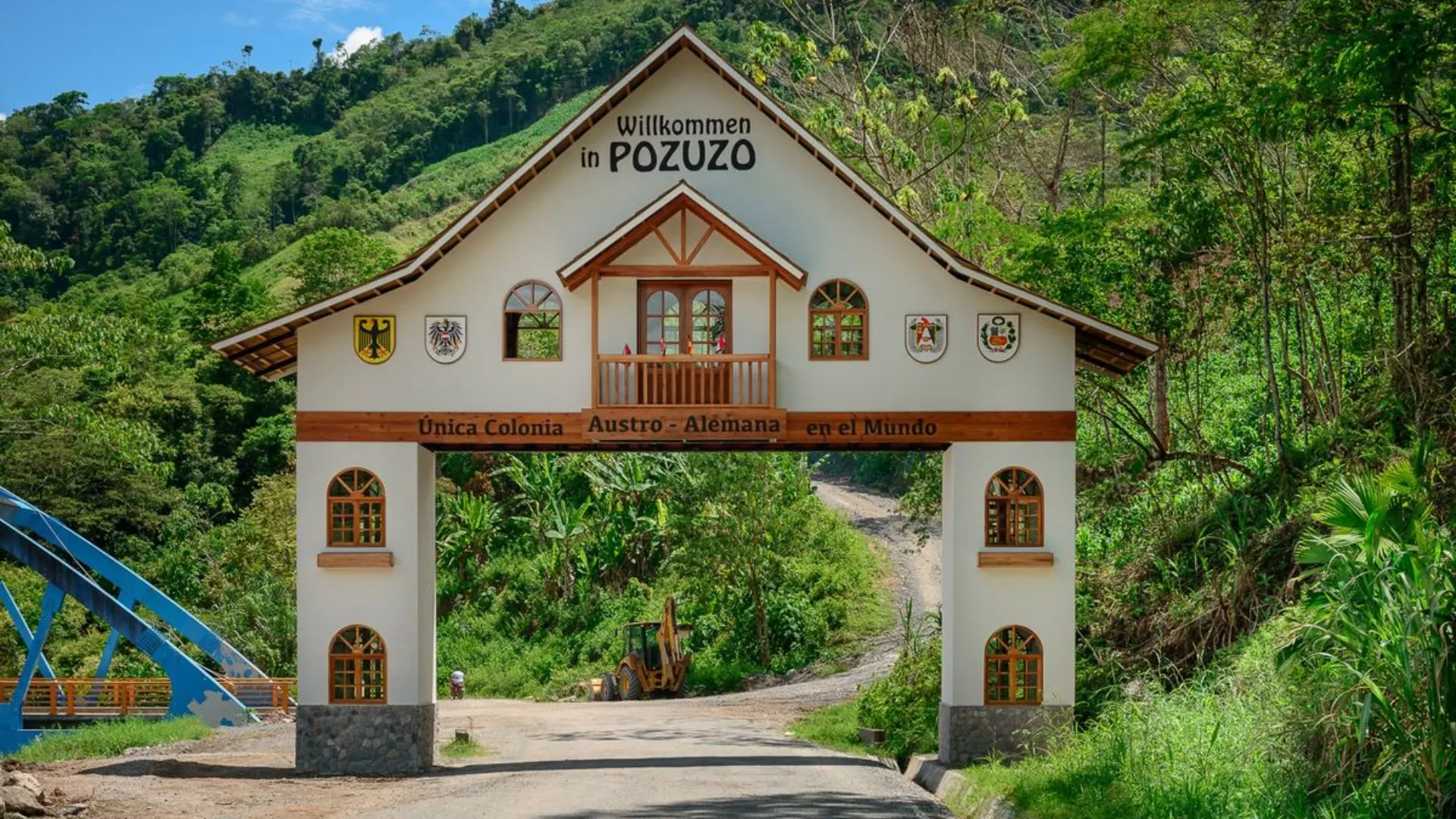
A Living Cultural Heritage
Pozuzo should not be understood simply as a "European village in Peru."
Its identity developed through the interaction of different communities and influences.
MINCETUR's inventory of Pozuzo specifically highlights the presence and interaction of Yánesha, Andean and Austro-German cultural influences in the area.
You can see this mixture in:
- Architecture
- Food
- Religious traditions
- Music
- Festivals
- Agriculture
- Local craftsmanship
- Family traditions
- Language and historical names
The result is a destination that feels distinctly Peruvian while retaining visible elements of its European heritage.
Best Things to Do in Pozuzo
1. Explore Plaza Los Colonos
A good place to begin discovering Pozuzo is Plaza Los Colonos.
The plaza was created to commemorate the history and cultural identity of the community and includes references to the different groups that shaped Pozuzo.
One of its most recognizable features is a replica of the Norton, the ship associated with the settlers' journey to Peru.
The plaza is also surrounded by several important cultural attractions, making it a convenient starting point for a walking tour.
Travel tip: Spend some time walking rather than simply stopping for photographs. The surrounding architecture and details tell much of Pozuzo's story.
2. Visit the San José Church
The San José Church is one of the most important historical buildings in Pozuzo.
Its history goes back to the early years of the settlement, and its interior preserves religious objects and artistic elements connected to the community's European heritage.
According to MINCETUR's tourism inventory, some of the religious objects were brought from Europe, while other elements of the church were crafted locally by settlers and craftsmen.
The church also illustrates how Catholic traditions became part of the community's cultural identity.
3. Walk Across the Emperador Guillermo I Bridge
One of Pozuzo's most recognizable landmarks is the Emperador Guillermo I Suspension Bridge.
The bridge crosses the Huancabamba River and is associated with the historical development of transportation and commerce in the colony.
Its construction began in the late 19th century, and the bridge was later associated with Emperor Wilhelm I of Prussia.
From the bridge and surrounding areas, visitors can appreciate the contrast between the historical settlement and the green landscapes of the valley.
For travelers interested in photography, this is one of the places where Pozuzo's cultural and natural character come together particularly well.

For travelers who enjoy gastronomy, Pozuzo is a particularly interesting stop because the food tells the story of migration and cultural adaptation.
When Is the Best Time to Visit Pozuzo?
Pozuzo can be visited throughout the year, but weather conditions are an important consideration because the region is part of the humid Selva Central.
For nature-focused activities, April to October is generally considered a favorable period.
SERNANP identifies April to October as the recommended visiting season for Yanachaga-Chemillén National Park, while November to March corresponds to a wetter period.
However, this does not mean that Pozuzo should only be visited during those months.
Rain is part of the environment that makes the region so green and biodiverse.
Quick guide
| Period | What to expect |
|---|---|
| April–October | Generally more favorable conditions for outdoor activities |
| June–August | Good option for combining culture and nature |
| November–March | Wetter conditions; lush landscapes but more possibility of rain |
| July | Important cultural celebrations around Pozuzo's anniversary |
July is particularly significant because Pozuzo celebrates its anniversary on July 25, with cultural, religious and community activities.
How to Get to Pozuzo
For international travelers, the journey normally begins in Lima before continuing toward the Selva Central.
One practical route is:
Lima → Oxapampa → Pozuzo
The official tourism information available through MINCETUR lists approximately 76 km between Oxapampa and Pozuzo, with a travel time of around 2 hours by road, although actual journey times can vary depending on road and traffic conditions.
PROMPERÚ's Selva Central travel material lists approximately:
Lima → Oxapampa: about 385 km / 10.5 hours
Oxapampa → Pozuzo: about 84 km / 2 hours
These figures are useful for itinerary planning, but road conditions and transportation schedules should always be confirmed before departure.
A more comfortable way to experience Pozuzo
For international travelers, especially those combining Pozuzo with Machu Picchu, the Amazon or other destinations, a private itinerary can make the journey significantly easier.
A tailored itinerary allows you to combine:
Lima → Oxapampa → Pozuzo → Cusco/Machu Picchu
or create a broader Selva Central journey incorporating Oxapampa, nature experiences and cultural communities.
How Many Days Do You Need in Pozuzo?
For a first visit, 2 nights in Pozuzo can provide enough time to experience the historic center, local gastronomy and nearby natural attractions without rushing.
Suggested 2-day experience
Day 1 – History & Culture
- Arrival from Oxapampa
- Plaza Los Colonos
- San José Church
- Museo Schafferer
- Cemetery of the Colonists
- Local dinner and gastronomy experience
Day 2 – Nature & Local Life
- Emperador Guillermo I Bridge
- Prusia
- Parque de la Identidad Pozucina
- Pozas de Agua y Sal or another nearby natural attraction
- Local lunch
- Return to Oxapampa or continue your private journey
For travelers with more time, Pozuzo works particularly well as part of a 3–5 day Selva Central extension.
Pozuzo for Luxury and Tailor-Made Travelers
Pozuzo is not a conventional luxury destination in the sense of large international resorts or extensive hotel infrastructure.
Its appeal is different.
The value lies in privacy, authenticity, local encounters and carefully designed experiences.
For travelers accustomed to Peru's classic luxury circuit, Pozuzo can provide a more intimate contrast to destinations such as Machu Picchu or the Sacred Valley.
A private experience could include:
- Private transportation from Oxapampa
- A local cultural guide
- Historical walking tour
- Gastronomic experiences
- Visits to local producers
- Nature walks
- Birdwatching
- Photography
- Time in rural communities
- Combination with Yanachaga-Chemillén
- Personalized accommodation selection
This is where a destination like Pozuzo works particularly well within a tailor-made Peru itinerary: not because it is crowded with luxury infrastructure, but because the experience itself can be personalized.
Pozuzo and Sustainable Travel
Pozuzo's appeal is closely connected to its landscape and cultural heritage.
The surrounding region forms part of the Oxapampa-Asháninka-Yánesha Biosphere Reserve, recognized by UNESCO in 2010. The wider landscape includes important ecosystems and Indigenous communities, making responsible tourism especially relevant.
When visiting Pozuzo, travelers can contribute to the destination by:
- Choosing locally owned accommodation and restaurants when possible
- Hiring local guides
- Purchasing locally produced crafts and food
- Respecting private property
- Following marked trails
- Avoiding litter
- Not disturbing wildlife
- Asking permission before photographing people
- Respecting religious and cultural spaces
- Supporting conservation initiatives
The goal is not simply to visit Pozuzo, but to help preserve what makes Pozuzo worth visiting.
Why Pozuzo Is One of Peru's Most Interesting Cultural Destinations
Pozuzo stands out because several stories coexist in one place.
It is a story of migration.
It is a story of adaptation.
It is a story of cultural exchange.
And it is also a story of nature and conservation.
The community established by European settlers did not simply reproduce European life in South America. Over generations, traditions evolved within the Peruvian environment and alongside other cultures of the Selva Central.
That is why walking through Pozuzo today feels different from visiting a conventional historical settlement.
The architecture may remind you of the Alps.
The food may evoke Austria or Germany.
The landscape is unmistakably tropical Peru.
And the identity of the community is distinctly Pozucina.
Pozuzo as a "Pueblo con Encanto"
In December 2025, Peru's Ministry of Foreign Trade and Tourism officially recognized Pozuzo as a Pueblo con Encanto del Perú through Ministerial Resolution N.° 067-2025-MINCETUR/VMT.
This recognition highlights the town's cultural authenticity, history, architecture and tourism potential.
It follows another significant international recognition: in 2023, UN Tourism selected Pozuzo among its Best Tourism Villages.
Together, these recognitions reflect the growing importance of Pozuzo as a cultural and nature destination within Peru.
Frequently Asked Questions About Pozuzo
Is Pozuzo worth visiting?
Pozuzo is particularly interesting for travelers who want to experience a less conventional side of Peru, combining cultural heritage, gastronomy, nature and the history of European migration.
Where is Pozuzo located?
Pozuzo is in the province of Oxapampa, department of Pasco, in Peru's Selva Central.
What is Pozuzo famous for?
Pozuzo is best known for its Austro-German heritage, traditional architecture, history of European colonization, distinctive cuisine and location in the biodiversity-rich Selva Central of Peru.
How far is Pozuzo from Oxapampa?
The road distance is approximately 76–84 km, depending on the route and reference point, and the journey generally takes around 2 hours under normal conditions.
Can I visit Pozuzo from Lima?
Look for local versions of Wurst, Wiener Schnitzel, strudel and Käsekuchen, together with local beer and other Peruvian-Selva Central dishes.
What should I eat in Pozuzo?
Look for local versions of Wurst, Wiener Schnitzel, strudel and Käsekuchen, together with local beer and other Peruvian-Selva Central dishes.
What is Pozuzo's elevation?
The wider Pozuzo district extends approximately from 600 to 1,850 meters above sea level.
Can I visit Pozuzo from Lima?
Yes. Pozuzo can be incorporated into a road itinerary from Lima through Oxapampa. For international travelers, a private multi-destination itinerary is generally the most practical way to combine it with other Peruvian destinations.
Is Pozuzo part of the Amazon?
Pozuzo is located in Peru's Selva Central, on the eastern side of the Andes and within the transition toward the Amazonian region. It is more accurate to describe it as part of the Peruvian Amazonian foothills/Selva Central rather than as a lowland Amazon city.
When should I visit Pozuzo?
April to October is generally a favorable period for combining Pozuzo with outdoor and nature activities, while the region can be visited throughout the year.
Pozuzo Travel Tips
Plan transportation in advance. Pozuzo is considerably more remote than Lima, Cusco or the Sacred Valley.
Don't rush the destination. The cultural experience is better when you allow time to walk, eat locally and speak with residents.
Bring rain protection. This is a humid tropical environment, even during the drier months.
Use local guides where appropriate. A knowledgeable guide can provide historical context that is easy to miss when exploring independently.
Combine culture and nature. Pozuzo is strongest when you experience both sides of the destination.
Respect the community. Pozuzo is a living community rather than an open-air museum.
A Different Side of Peru
Peru is often introduced through its most famous landmarks: Machu Picchu, the Sacred Valley, Lake Titicaca, the Amazon and the Nazca Lines.
But the country becomes even more fascinating when you travel beyond its most familiar routes.
Pozuzo is one of those places.
Here, the story of European migration meets the cultures of the Peruvian Andes and Selva Central. Historic wooden houses stand beneath tropical mountains. Traditional recipes have crossed generations. Rivers and forests surround a community whose identity has been shaped by more than 160 years of history.
For travelers looking for authentic cultural experiences, nature and destinations beyond the usual tourist circuit, Pozuzo deserves a place on the map.
And when combined with Oxapampa, Yanachaga-Chemillén and other destinations of the Selva Central, it can become part of a very different kind of Peru journey.
Experience Pozuzo with Andean Travel Experience
At Andean Travel Experience, we believe Peru is best discovered through journeys designed around the traveler not simply through a list of famous attractions.
A visit to Pozuzo can be incorporated into a personalized Peru itinerary combining Lima, Oxapampa, Pozuzo, the Amazon, Cusco and Machu Picchu, depending on your interests, travel style and available time.
Whether you are interested in Peruvian culture, gastronomy, nature, photography, history or authentic local experiences, we can help create a private journey that connects these different sides of Peru.
Ready to discover a different side of Peru?
Plan Your Private Peru Journey
Tell us what you want to experience, and we'll design a journey around you.